← All this month’s guidesHTML guideChair version →

AstroYoga · Kriyā on the mat

Revatī

Decreasing carrying support — restored availability

Support→Target→Integration
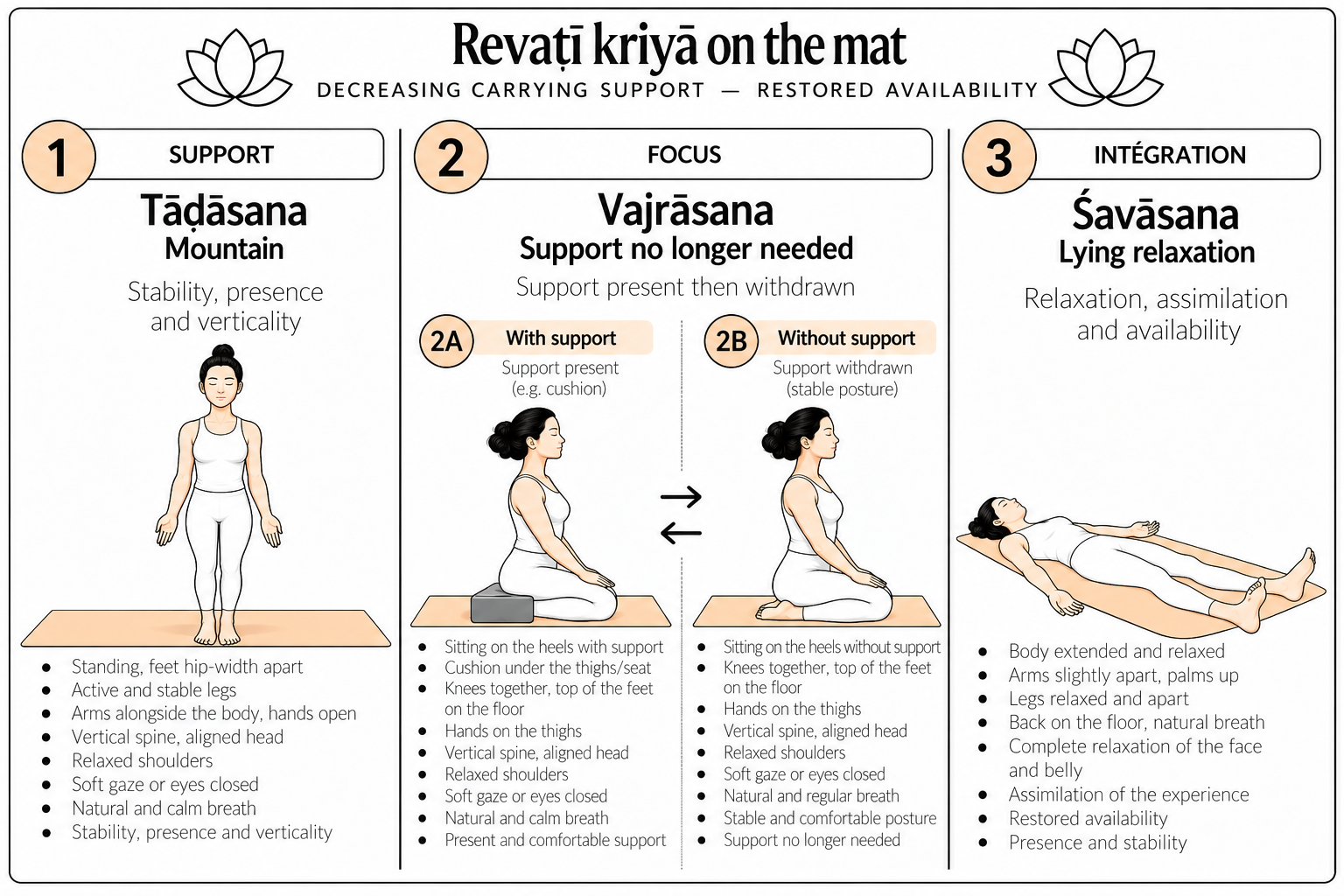
Revatī kriyā on the mat
01

Support

Tāḍāsana

Mountain

Concrete purposeGradually reduce carrying support until it becomes unnecessary and availability can be restored to the body.

1. Settle in

Stand with feet parallel and comfortably apart, weight shared between both feet, knees free, pelvis and rib cage stacked without rigidity.

2. Enter and hold

Support — Tāḍāsana — Mountain. Let the arms and gaze settle. Check that standing is stable before continuing; do not add anticipatory tension for the next phase.

Desired sensation

Practice is complete when the chosen aid can be fully removed without compensatory effort, needing to preserve the resulting form or losing functional comfort ; the supported part can freely return to an ordinary position ; and neutral remains awake, alive and complete enough for the session to truly end.

Success criterion

Practice is complete when the chosen aid can be fully removed without compensatory effort, needing to preserve the resulting form or losing functional comfort ; the supported part can freely return to an ordinary position ; and neutral remains awake, alive and complete enough for the session to truly end. Success is not staying unsupported as long as possible. It is recognising that support has fulfilled its function and can now become unnecessary.

Adaptations, exit and precautions

Simple variationReduce range or duration and return to the last form in which support, breath and return remain simple. The reduced version preserves the same operative logic.

Mistakes to avoidRemoving support needed for safety or holding the form as help disappears. Do not add a second intensification once the phase criterion is met.

Physical cautionsReduce or stop in case of pain, dizziness, numbness, increasing joint discomfort or lasting loss of comfortable breathing. No maximum range is sought.

02

Target

Vajrāsana

support no longer needed

1. Settle in

From Support, prepare the transition towards Vajrāsana — support no longer needed. Settle comfortably into Vajrāsana, hands on thighs and weight clearly received by sitting.

2. Enter and hold

Target — Vajrāsana — support no longer needed. Identify the support still deliberately maintained — hand pressure, trunk rigidity or control of sitting — then gradually reduce it until no longer required. Choose one auxiliary aid and reduce it in at most two small stages : broad support, reduced support, then zero support. Dosage : Broad support → reduced support → zero auxiliary help, at most two decreasing stages. One arm is enough. The session must be able to end after Integration.

Desired sensation

Practice is complete when the chosen aid can be fully removed without compensatory effort, needing to preserve the resulting form or losing functional comfort ; the supported part can freely return to an ordinary position ; and neutral remains awake, alive and complete enough for the session to truly end.

Success criterion

Practice is complete when the chosen aid can be fully removed without compensatory effort, needing to preserve the resulting form or losing functional comfort ; the supported part can freely return to an ordinary position ; and neutral remains awake, alive and complete enough for the session to truly end. Success is not staying unsupported as long as possible. It is recognising that support has fulfilled its function and can now become unnecessary.

Adaptations, exit and precautions

Simple variationReduce range or duration and return to the last form in which support, breath and return remain simple. The reduced version preserves the same operative logic.

Mistakes to avoidRemoving support needed for safety or holding the form as help disappears. Do not add a second intensification once the phase criterion is met.

Physical cautionsReduce or stop in case of pain, dizziness, numbness, increasing joint discomfort or lasting loss of comfortable breathing. No maximum range is sought.

03

Integration

Śavāsana

Lying relaxation

Leaving the posture

Integration — Śavāsana — Lying relaxation. Lie on the back, legs and arms comfortably placed, head aligned and weight fully given to the floor. Stop all unnecessary voluntary action. Let breathing regulate itself and check that the body no longer tries to prolong the previous phase. After fully removing the chosen aid, return to an awake neutral where nothing needs holding.

Desired sensation

Practice is complete when the chosen aid can be fully removed without compensatory effort, needing to preserve the resulting form or losing functional comfort ; the supported part can freely return to an ordinary position ; and neutral remains awake, alive and complete enough for the session to truly end.

Success criterion

Practice is complete when the chosen aid can be fully removed without compensatory effort, needing to preserve the resulting form or losing functional comfort ; the supported part can freely return to an ordinary position ; and neutral remains awake, alive and complete enough for the session to truly end. Success is not staying unsupported as long as possible. It is recognising that support has fulfilled its function and can now become unnecessary.

Adaptations, exit and precautions

Simple variationReduce range or duration and return to the last form in which support, breath and return remain simple. The reduced version preserves the same operative logic.

Leaving the postureIntegration — Śavāsana — Lying relaxation. Lie on the back, legs and arms comfortably placed, head aligned and weight fully given to the floor. Stop all unnecessary voluntary action. Let breathing regulate itself and check that the body no longer tries to prolong the previous phase. After fully removing the chosen aid, return to an awake neutral where nothing needs holding.

Mistakes to avoidRemoving support needed for safety or holding the form as help disappears. Do not add a second intensification once the phase criterion is met.

Physical cautionsReduce or stop in case of pain, dizziness, numbness, increasing joint discomfort or lasting loss of comfortable breathing. No maximum range is sought.