← All this month’s guidesHTML guideChair version

AstroYoga · Kriyā on the mat

Āśleṣā

Enter finely into the diaphragm-stomach area to illuminate the knot without forcing.

SupportTargetIntegration
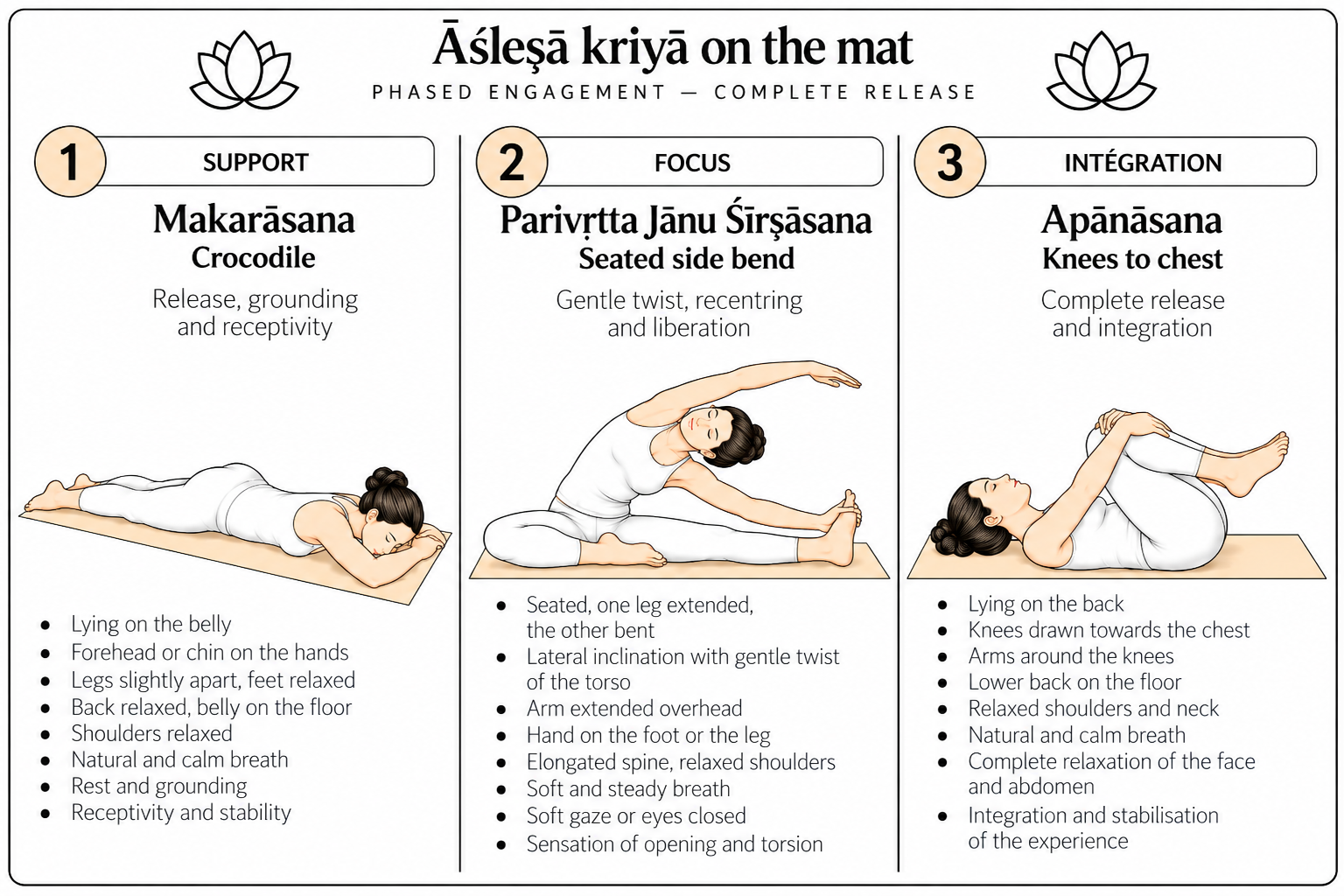
The three postures of the Āśleṣā kriyā on the mat
01

Support

Adho Mukha Vīrāsana

Downward-Facing Hero

Concrete purposeCalm the surface and make the breath subtle enough to approach the inner knot.

1. Settle in

Kneel down. Move the pelvis back toward the heels. Separate the knees slightly if the abdomen needs space.

Place the forehead on the floor or on a support. Choose arms forward or alongside the body according to ease of entry into the posture.

2. Enter and hold

Let the weight of the pelvis descend. Release the neck. Then let the area under the ribs calm on the exhale.

Breathe discreetly into the back and flanks. Keep the upper abdomen soft. Withdraw surface effort.

Desired sensation

Feel less inner noise, with the diaphragm and upper abdomen a little softer.

Success criterion

The breathing becomes more discreet, the upper abdomen releases, and the body does not collapse.

Adaptations, exit and precautions

Simple variationPlace a cushion under the forehead or between the pelvis and heels.

Exiting the postureReturn slowly to vertical. Keep the head low until the last moment.

Mistakes to avoidPushing the breath toward the abdomen. Collapsing completely. Trying already to undo the knot.

ContraindicationsAcute knee pain, respiratory discomfort if the flexion is too closed, significant reflux depending on the time of practice.

02

Target

Parivṛtta Jānu Śīrṣāsana

Twisted Half Forward Bend

Concrete purposeEnter finely into the diaphragm-stomach area to illuminate the knot without forcing.

1. Settle in

Sit with the legs simply apart. Bend one leg and bring the foot against the inner thigh of the opposite leg.

Lengthen the spine. Stabilize the sitting bones on the floor. Place one hand on the floor or on a support.

2. Enter and hold

On the inhale, lengthen the trunk. On the exhale, incline the torso toward the extended leg. Open the chest slightly toward the ceiling. Pass the upper arm over the ear without pulling.

Let the flank, lower ribs and diaphragm become perceptible. Keep the gesture moderate. Breathe into the stretched area.

Desired sensation

Feel, under the ribs and around the diaphragm, an area becoming more readable even before it truly releases.

Success criterion

The gesture remains moderate, the flank opens without pain, and the breath enters the stretched area without forcing.

Adaptations, exit and precautions

Simple variationKeep the upper arm resting on the hip or use a higher support under the lower hand.

Exiting the postureReturn slowly to center on an inhale. Wait one breath before changing sides.

Mistakes to avoidSeeking a large stretch. Forcing the rotation of the chest. Hardening the throat or face.

ContraindicationsLow back pain in lateral bending, significant hamstring limitation without support, acute rib discomfort.

03

Integration

Supta Baddha Koṇāsana Supported

Supported Bound Angle

Concrete purposeLet the knot undo itself without further intervention.

1. Settle in

Lie down on an inclined support or on the floor. Bring the soles of the feet together. Support the knees.

Place the hands on the lower ribs, diaphragm or upper abdomen. Keep the sternum simple. Release the face and tongue.

2. Enter and hold

Take time to settle. Do not seek a large opening. Let the breath become more inward.

Remain quiet. Let the diaphragm and upper abdomen modify little by little. Do not analyze.

Desired sensation

Feel a slight loosening in the diaphragm and upper abdomen, with more inner simplicity.

Success criterion

The breath becomes fine and continuous, the face relaxes, and the central area seems less compact.

Adaptations, exit and precautions

Simple variationExtend the legs or keep the feet farther away from the pelvis.

Exiting the postureGently close the knees. Roll onto one side. Slowly sit back up.

Mistakes to avoidWanting to open the chest further. Adding an act of will. Returning to analysis.

ContraindicationsLumbar discomfort without support, painful hip opening, feeling of excessive exposure if the chest is too open.