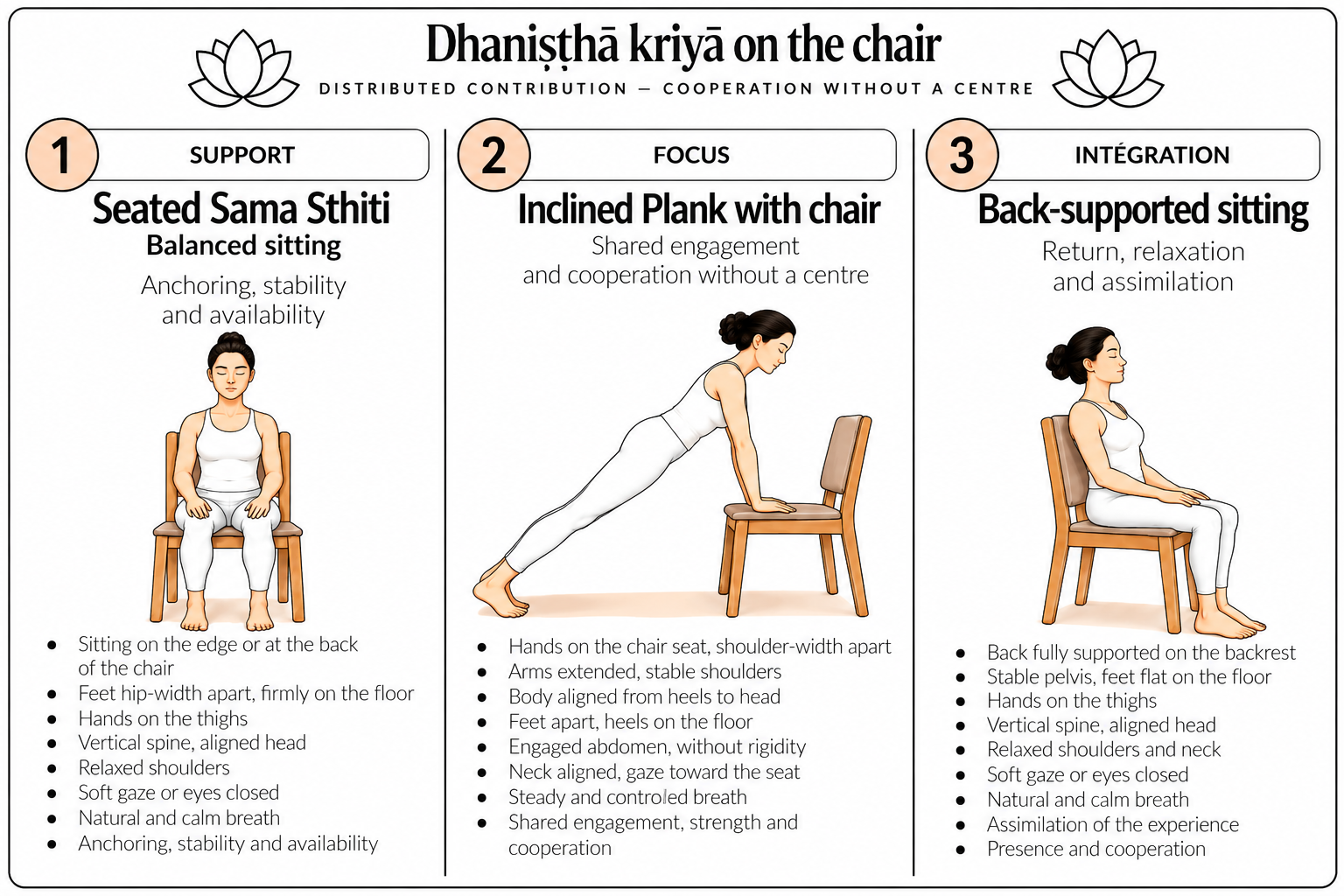
Support
Seated Sama Sthiti
Balanced sittingConcrete purposeDistribute effort across several supports and segments without letting a single centre take the whole load.
1. Settle in
Sit in the centre of the chair, feet fully grounded, knees comfortably bent, pelvis stable and hands on the thighs.
2. Enter and hold
Support — Seated Sama Sthiti — Balanced sitting. Organise the trunk above the pelvis without rigidity. Keep the backrest available without leaning on it unless the phase calls for it.
Desired sensation
Practice is complete when a very small contribution has passed through at least three distinct supports without acceleration, tension, fully lifting a support or forced breathing changes ; and alternation can then stop while several supports keep cooperating without mandatory central support.
Success criterion
Practice is complete when a very small contribution has passed through at least three distinct supports without acceleration, tension, fully lifting a support or forced breathing changes ; and alternation can then stop while several supports keep cooperating without mandatory central support. Success depends neither on transfer count, symmetry nor equal distribution. The true endpoint is the absence of a need to continue handover.
Adaptations, exit and precautions
Simple variationReduce the range, keep more contact with the seat or backrest, or stay at the first stable stage. The variation must preserve the same grammar without turning the chair into a lever.
Mistakes to avoidTurning handover into rocking, cadence or lifting a support. Do not add a second intensification once the phase criterion is met.
Physical cautionsReduce or stop in case of pain, dizziness, numbness, increasing joint discomfort or lasting loss of comfortable breathing. No maximum range is sought. Check that the chair is stable, has no wheels and never becomes a pulling lever. Protect wrists and shoulders : reduce duration or angle if the load concentrates in a joint.