← All this month’s guidesHTML guideChair version →

AstroYoga · Kriyā on the mat

Dhaniṣṭhā

Distributed contribution — cooperation without a centre

Support→Target→Integration
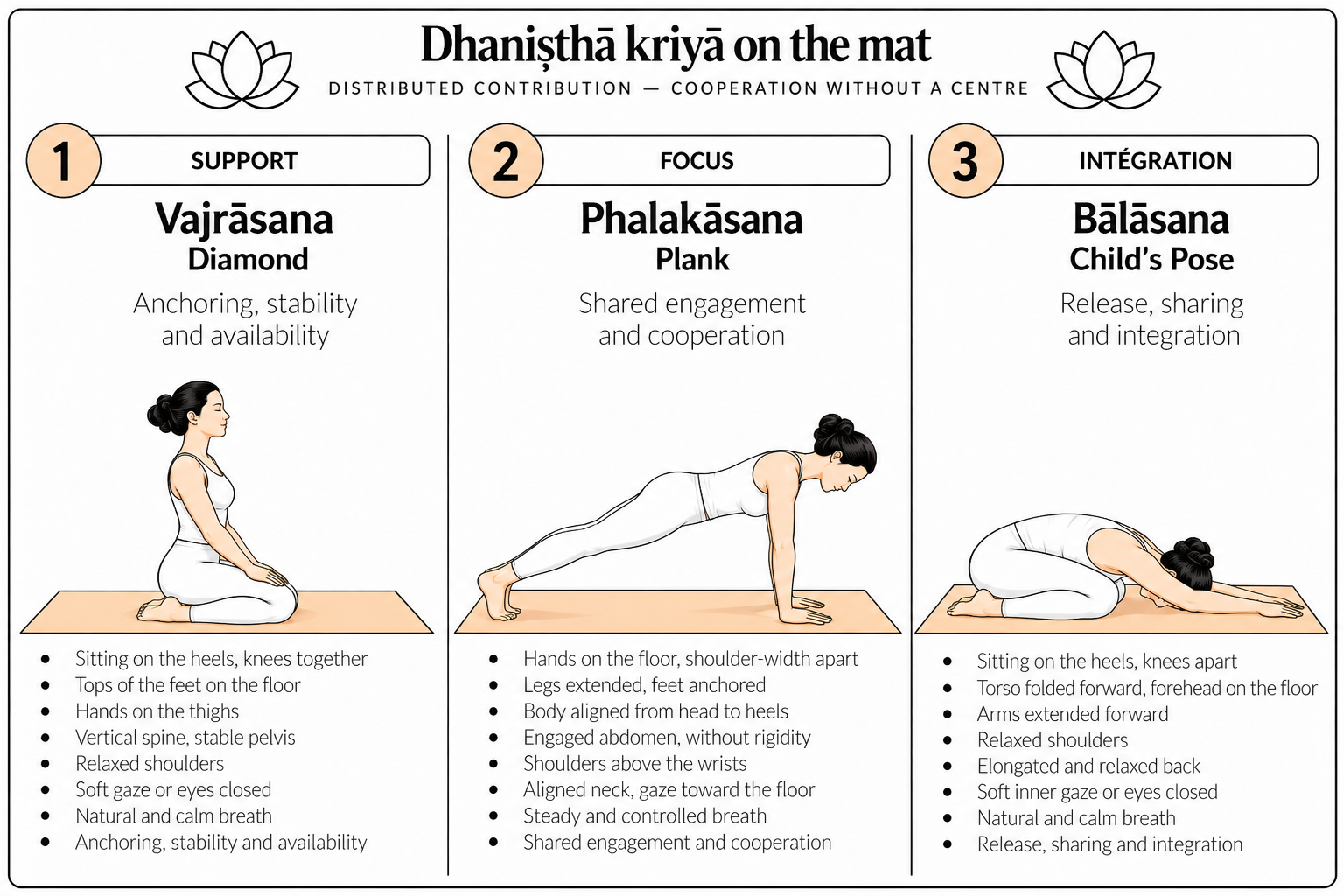
Dhaniṣṭhā kriyā on the mat
01

Support

Vajrāsana

Diamond

Concrete purposeDistribute effort across several supports and segments without letting a single centre take the whole load.

1. Settle in

Kneel, then sit on the heels as far as knees and ankles remain comfortable. Rest the hands simply on the thighs.

2. Enter and hold

Support — Vajrāsana — Diamond. Let sitting receive the weight and keep the trunk upright without overcorrecting. The posture serves here as a stable form, not a performance of range.

Desired sensation

Practice is complete when a very small contribution has passed through at least three distinct supports without acceleration, tension, fully lifting a support or forced breathing changes ; and alternation can then stop while several supports keep cooperating without mandatory central support.

Success criterion

Practice is complete when a very small contribution has passed through at least three distinct supports without acceleration, tension, fully lifting a support or forced breathing changes ; and alternation can then stop while several supports keep cooperating without mandatory central support. Success depends neither on transfer count, symmetry nor equal distribution. The true endpoint is the absence of a need to continue handover.

Adaptations, exit and precautions

Simple variationReduce the duration and loading angle ; return sooner to the Support or Integration phase. Transition quality takes precedence over depth or holding time.

Mistakes to avoidTurning handover into rocking, cadence or lifting a support. Do not add a second intensification once the phase criterion is met.

Physical cautionsReduce or stop in case of pain, dizziness, numbness, increasing joint discomfort or lasting loss of comfortable breathing. No maximum range is sought. Protect wrists and shoulders : reduce duration or angle if the load concentrates in a joint.

02

Target

Phalakāsana

Plank

1. Settle in

From Support, prepare the transition towards Phalakāsana — Plank. Place the hands under or slightly ahead of the shoulders, step the feet back and organise a continuous line from head to heels within a range that allows comfortable breathing.

2. Enter and hold

Target — Phalakāsana — Plank. Press evenly into the floor, keep the centre active without arching the lower back and avoid transferring the whole load to the shoulders. Keep all supports in contact. Dosage : At most two or three pressure handovers, without lifting support or establishing cadence. One handover may suffice if redistribution is clear.

Desired sensation

Practice is complete when a very small contribution has passed through at least three distinct supports without acceleration, tension, fully lifting a support or forced breathing changes ; and alternation can then stop while several supports keep cooperating without mandatory central support.

Success criterion

Practice is complete when a very small contribution has passed through at least three distinct supports without acceleration, tension, fully lifting a support or forced breathing changes ; and alternation can then stop while several supports keep cooperating without mandatory central support. Success depends neither on transfer count, symmetry nor equal distribution. The true endpoint is the absence of a need to continue handover.

Adaptations, exit and precautions

Simple variationReduce the duration and loading angle ; return sooner to the Support or Integration phase. Transition quality takes precedence over depth or holding time.

Mistakes to avoidTurning handover into rocking, cadence or lifting a support. Do not add a second intensification once the phase criterion is met.

Physical cautionsReduce or stop in case of pain, dizziness, numbness, increasing joint discomfort or lasting loss of comfortable breathing. No maximum range is sought. Protect wrists and shoulders : reduce duration or angle if the load concentrates in a joint.

03

Integration

Bālāsana

Child’s Pose

Leaving the posture

Integration — Bālāsana — Child’s Pose. From kneeling support, move the pelvis back towards the heels and let the trunk incline forward within a comfortable range. Release what can be released without forcing the forehead towards the floor. Let the posture gradually receive the weight. Stop all alternation before it becomes automatic.

Desired sensation

Practice is complete when a very small contribution has passed through at least three distinct supports without acceleration, tension, fully lifting a support or forced breathing changes ; and alternation can then stop while several supports keep cooperating without mandatory central support.

Success criterion

Practice is complete when a very small contribution has passed through at least three distinct supports without acceleration, tension, fully lifting a support or forced breathing changes ; and alternation can then stop while several supports keep cooperating without mandatory central support. Success depends neither on transfer count, symmetry nor equal distribution. The true endpoint is the absence of a need to continue handover.

Adaptations, exit and precautions

Simple variationReduce the duration and loading angle ; return sooner to the Support or Integration phase. Transition quality takes precedence over depth or holding time.

Leaving the postureIntegration — Bālāsana — Child’s Pose. From kneeling support, move the pelvis back towards the heels and let the trunk incline forward within a comfortable range. Release what can be released without forcing the forehead towards the floor. Let the posture gradually receive the weight. Stop all alternation before it becomes automatic.

Mistakes to avoidTurning handover into rocking, cadence or lifting a support. Do not add a second intensification once the phase criterion is met.

Physical cautionsReduce or stop in case of pain, dizziness, numbness, increasing joint discomfort or lasting loss of comfortable breathing. No maximum range is sought. Protect wrists and shoulders : reduce duration or angle if the load concentrates in a joint.