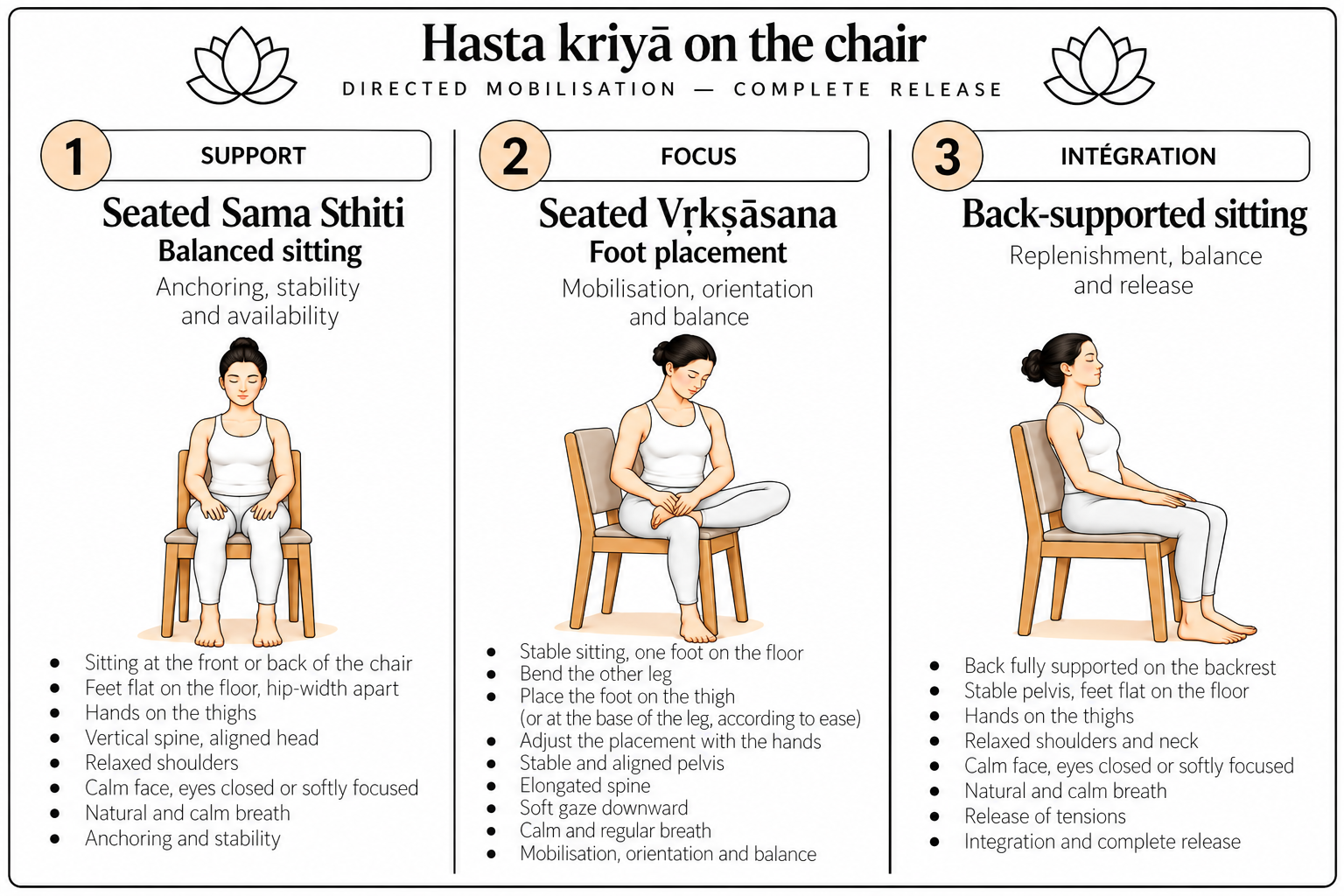
Support
Seated Sama Sthiti
Balanced sittingConcrete purposeMobilise a precise action, direct it clearly, then release it completely instead of retaining a residual grip.
1. Settle in
Sit in the centre of the chair, feet fully grounded, knees comfortably bent, pelvis stable and hands on the thighs.
2. Enter and hold
Support — Seated Sama Sthiti — Balanced sitting. Organise the trunk above the pelvis without rigidity. Keep the backrest available without leaning on it unless the phase calls for it.
Desired sensation
The movement is complete when the object is taken, oriented if needed, then placed exactly at the marker with minimum finger pressure ; after placing, the hand can immediately release every form of grip ; and breathing remains ordinary.
Success criterion
The movement is complete when the object is taken, oriented if needed, then placed exactly at the marker with minimum finger pressure ; after placing, the hand can immediately release every form of grip ; and breathing remains ordinary. Success depends neither on repetition count, speed nor manual finesse. One clean grasp–place action is enough.
Adaptations, exit and precautions
Simple variationReduce the range, keep more contact with the seat or backrest, or stay at the first stable stage. The variation must preserve the same grammar without turning the chair into a lever.
Mistakes to avoidTurning hand precision into whole-body tension or perfectionist repetition. Do not add a second intensification once the phase criterion is met.
Physical cautionsReduce or stop in case of pain, dizziness, numbness, increasing joint discomfort or lasting loss of comfortable breathing. No maximum range is sought. Check that the chair is stable, has no wheels and never becomes a pulling lever. Prioritise balance and stable supports ; reduce range before losing control of return.