← All this month’s guidesHTML guideChair version →

AstroYoga · Kriyā on the mat

Maghā

Active cessation — handover to support

Support→Target→Integration
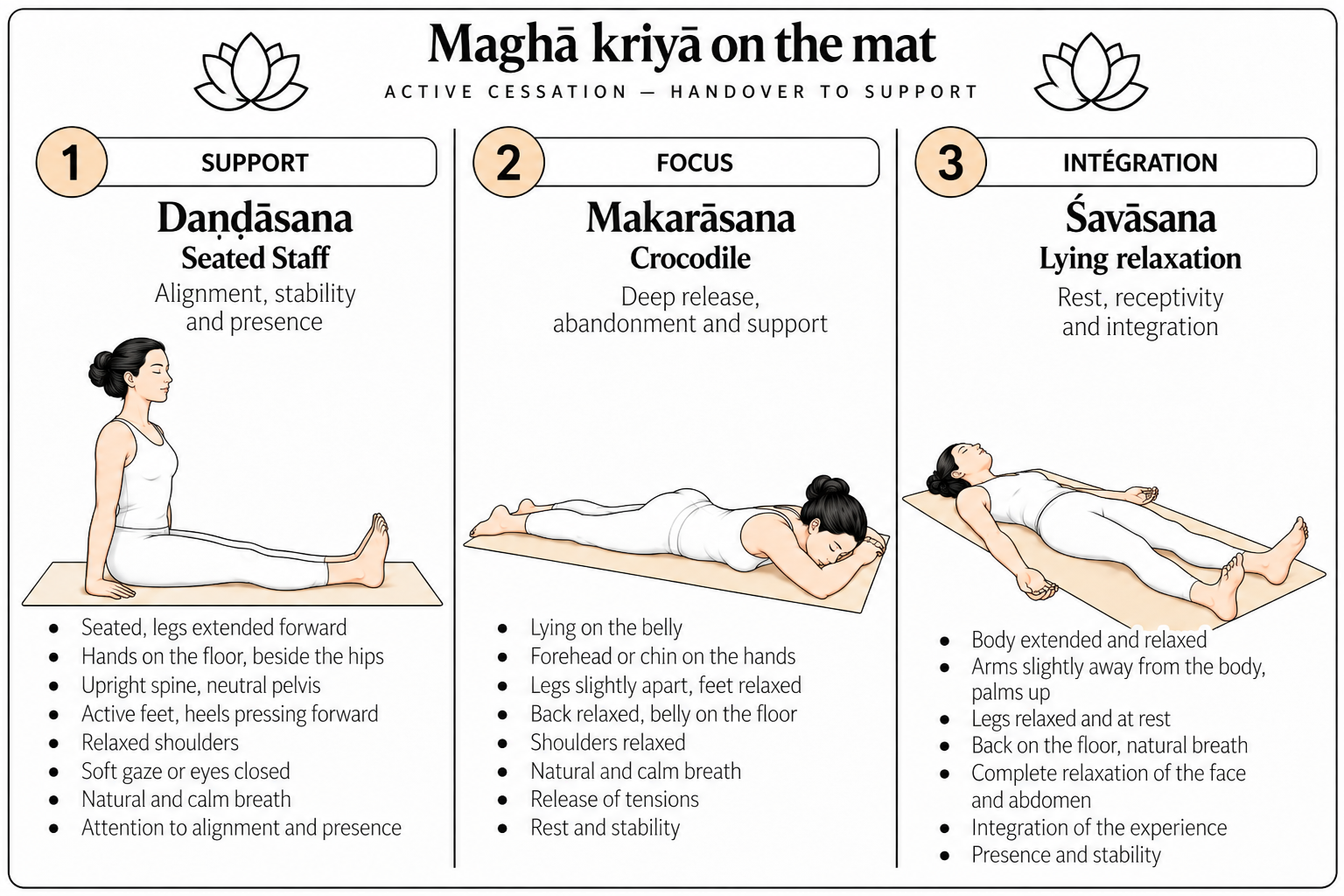
Maghā kriyā on the mat
01

Support

Daṇḍāsana

Seated Staff

Concrete purposeDeliberately cease active action and let support take over without retaining unnecessary guarding tone.

1. Settle in

Sit with legs extended in front, clear support on sitting bones, spine upright and hands on the floor or thighs without unnecessary pushing.

2. Enter and hold

Support — Daṇḍāsana — Seated Staff. Establish a firm sitting base that allows breathing. Keep the legs just active enough to support the axis without stiffening the face or shoulders.

Desired sensation

The movement is complete when the active effort identified initially can truly decrease because external support receives the load ; contact occurs without falling or impact ; breath, throat and neck remain free ; and exit requires only enough effort to leave support, without rebound or compensatory straightening.

Success criterion

The movement is complete when the active effort identified initially can truly decrease because external support receives the load ; contact occurs without falling or impact ; breath, throat and neck remain free ; and exit requires only enough effort to leave support, without rebound or compensatory straightening. The criterion is neither height, chest opening nor time spent in the supported posture.

Adaptations, exit and precautions

Simple variationReduce range or duration and return to the last form in which support, breath and return remain simple. The reduced version preserves the same operative logic.

Mistakes to avoidContinuing to work when support should take over. Do not add a second intensification once the phase criterion is met.

Physical cautionsReduce or stop in case of pain, dizziness, numbness, increasing joint discomfort or lasting loss of comfortable breathing. No maximum range is sought.

02

Target

Makarāsana

Crocodile

1. Settle in

From Support, prepare the transition towards Makarāsana — Crocodile. Lie on the belly and arrange the forearms so the upper body can rest without neck tension.

2. Enter and hold

Target — Makarāsana — Crocodile. Let the floor receive the front of the body, relax the legs and keep breathing free in the back and sides. End active effort, then let external support gradually receive the load. Dosage : Śalabhāsana for 1–2 breaths ; half Bridge support for 2–4 breaths if comfortable ; brief integration without rebuilding verticality.

Desired sensation

The movement is complete when the active effort identified initially can truly decrease because external support receives the load ; contact occurs without falling or impact ; breath, throat and neck remain free ; and exit requires only enough effort to leave support, without rebound or compensatory straightening.

Success criterion

The movement is complete when the active effort identified initially can truly decrease because external support receives the load ; contact occurs without falling or impact ; breath, throat and neck remain free ; and exit requires only enough effort to leave support, without rebound or compensatory straightening. The criterion is neither height, chest opening nor time spent in the supported posture.

Adaptations, exit and precautions

Simple variationReduce range or duration and return to the last form in which support, breath and return remain simple. The reduced version preserves the same operative logic.

Mistakes to avoidContinuing to work when support should take over. Do not add a second intensification once the phase criterion is met.

Physical cautionsReduce or stop in case of pain, dizziness, numbness, increasing joint discomfort or lasting loss of comfortable breathing. No maximum range is sought.

03

Integration

Śavāsana

Lying relaxation

Leaving the posture

Integration — Śavāsana — Lying relaxation. Lie on the back, legs and arms comfortably placed, head aligned and weight fully given to the floor. Stop all unnecessary voluntary action. Let breathing regulate itself and check that the body no longer tries to prolong the previous phase. Remain briefly and genuinely supported without correcting the form to preserve an impression of verticality or dignity.

Desired sensation

The movement is complete when the active effort identified initially can truly decrease because external support receives the load ; contact occurs without falling or impact ; breath, throat and neck remain free ; and exit requires only enough effort to leave support, without rebound or compensatory straightening.

Success criterion

The movement is complete when the active effort identified initially can truly decrease because external support receives the load ; contact occurs without falling or impact ; breath, throat and neck remain free ; and exit requires only enough effort to leave support, without rebound or compensatory straightening. The criterion is neither height, chest opening nor time spent in the supported posture.

Adaptations, exit and precautions

Simple variationReduce range or duration and return to the last form in which support, breath and return remain simple. The reduced version preserves the same operative logic.

Leaving the postureIntegration — Śavāsana — Lying relaxation. Lie on the back, legs and arms comfortably placed, head aligned and weight fully given to the floor. Stop all unnecessary voluntary action. Let breathing regulate itself and check that the body no longer tries to prolong the previous phase. Remain briefly and genuinely supported without correcting the form to preserve an impression of verticality or dignity.

Mistakes to avoidContinuing to work when support should take over. Do not add a second intensification once the phase criterion is met.

Physical cautionsReduce or stop in case of pain, dizziness, numbness, increasing joint discomfort or lasting loss of comfortable breathing. No maximum range is sought.