← All this month’s guidesHTML guideMat version

AstroYoga · Kriyā on a chair · 7

Punarvasu

Gently reinhabit the chest, diaphragm, and breath.

SupportTargetIntegration
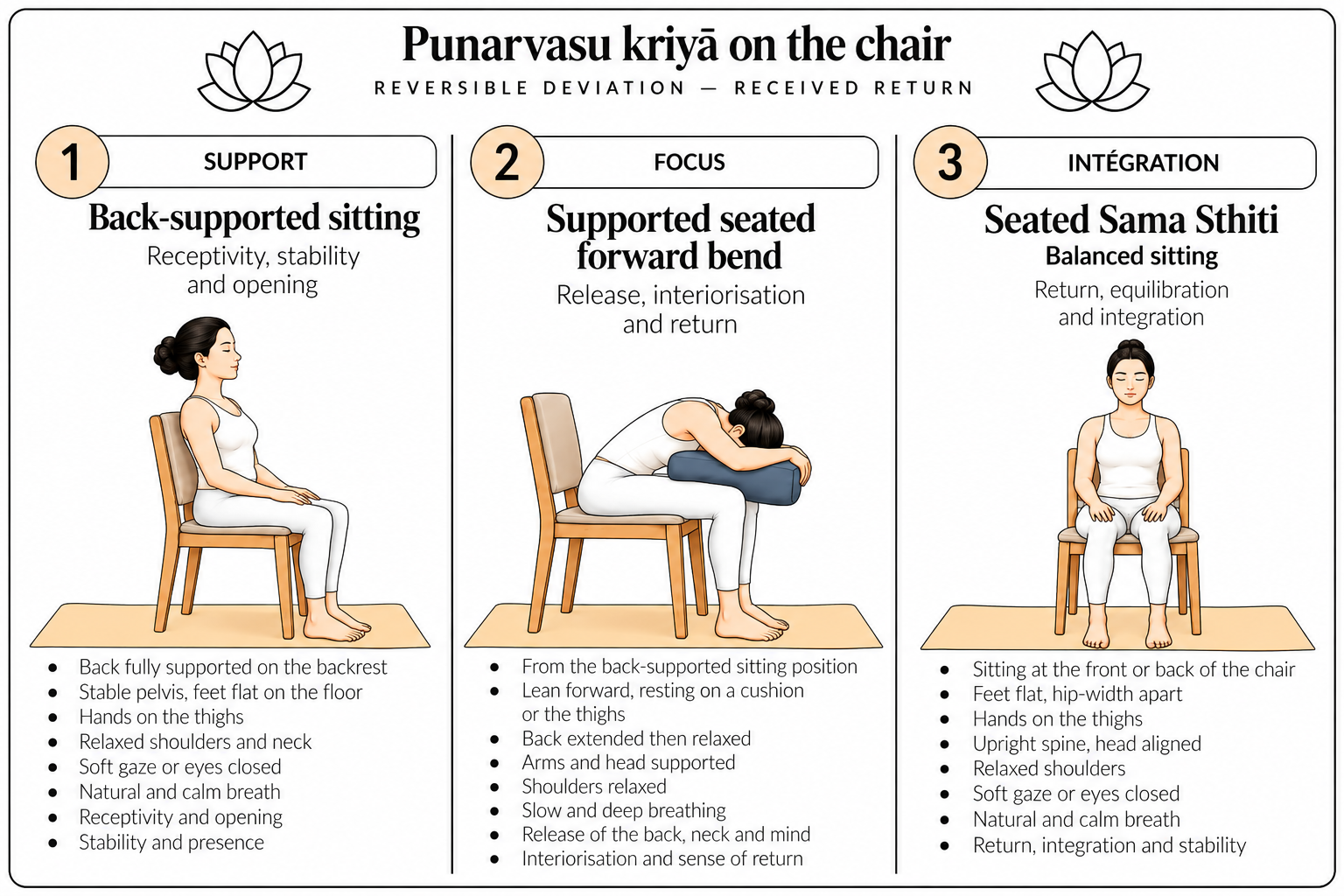
The three postures of the Punarvasu kriyā on a chair
01

Support

Supported seated forward bend

Concrete purposeReduce dispersion and restore posterior breathing before reopening the chest.

1. Settle in

Sit in the middle of the chair. Ground the feet. Slightly separate the feet.

Incline the trunk forward from the hips. Place the forearms, hands, or forehead on a support.

2. Enter and hold

Let the pelvis remain heavy. Broaden the back. Calm the floating quality.

Breathe into the back and between the shoulder blades. Remain in a supported but simple forward bend.

Desired sensation

Sense the breath returning into the back and the dispersion calming before the opening.

Success criterion

The breath recovers a more regular and more gathered form.

Adaptations, exit and precautions

Simple variationPlace only the forearms on the thighs.

Exiting the postureStraighten the trunk slowly. Return to the center. Allow one transitional breath.

Mistakes to avoidCreating too strong a forward bend. Collapsing completely. Seeking the opening already.

ContraindicationsSignificant reflux, respiratory discomfort in flexion, hip pain preventing the forward inclination.

02

Target

Supported seated opening

Concrete purposeGently reinhabit the chest, diaphragm, and breath.

1. Settle in

Sit so that the upper back can rest against the backrest or against a small support. Place the feet firmly on the floor.

Place one hand on the sternum and the other on the diaphragm or lower ribs. Let the back rest without collapsing. Lengthen the back of the neck.

2. Enter and hold

On a soft inhalation, let the sternum rise very slightly. Let the chest open without leaving the support. Keep the diaphragm available and the throat free.

Let the back receive the support. Keep the diaphragm supple. Remain in a quiet, restorative opening rather than an active passage.

Desired sensation

Sense the chest and diaphragm gradually being reinhabited, without effort or demonstration.

Success criterion

The support remains present, the sternum rises only slightly, and the breath returns to the center of the thorax.

Adaptations, exit and precautions

Simple variationKeep both hands on the thighs and allow only a small lift of the sternum.

Exiting the postureReturn slowly to a neutral seated position. Release the hands. Allow one calm breath.

Mistakes to avoidTurning the support into a strong extension. Collapsing on the exhalation. Making the return demonstrative.

ContraindicationsNeck pain, thoracic discomfort if the support is too high, dizziness in opening.

03

Integration

Sama Sthiti seated

Hands on sternum and diaphragm

Concrete purposeRecognize the return and make it stable, simple, and portable.

1. Settle in

Sit in the center of the chair. Place the feet parallel.

Place one hand on the sternum and the other on the diaphragm or lower ribs. Lengthen the spine without rigidity.

2. Enter and hold

Let the shoulders descend. Keep the throat quiet. Set the gaze forward or slightly downward.

Let the breath become regular, reharmonizing, and recentring. Sense the agreement between chest, diaphragm, and throat.

Desired sensation

Sense a simple and stable return in the chest and diaphragm.

Success criterion

The hands can remain placed without tension, the breath is regular, and the opening remains quiet.

Adaptations, exit and precautions

Simple variationPlace both hands on the thighs while keeping the same quality of breath.

Exiting the postureRelease the hands. Return to a simple seated position.

Mistakes to avoidStill trying to open. Collapsing. Confusing return with limp relaxation.

ContraindicationsLumbar discomfort in unsupported sitting, agitation increased by immobility.