← All this month’s guidesHTML guideChair version →

AstroYoga · Kriyā on the mat

Puṣya

Formative continuity under stable conditions

Support→Target→Integration
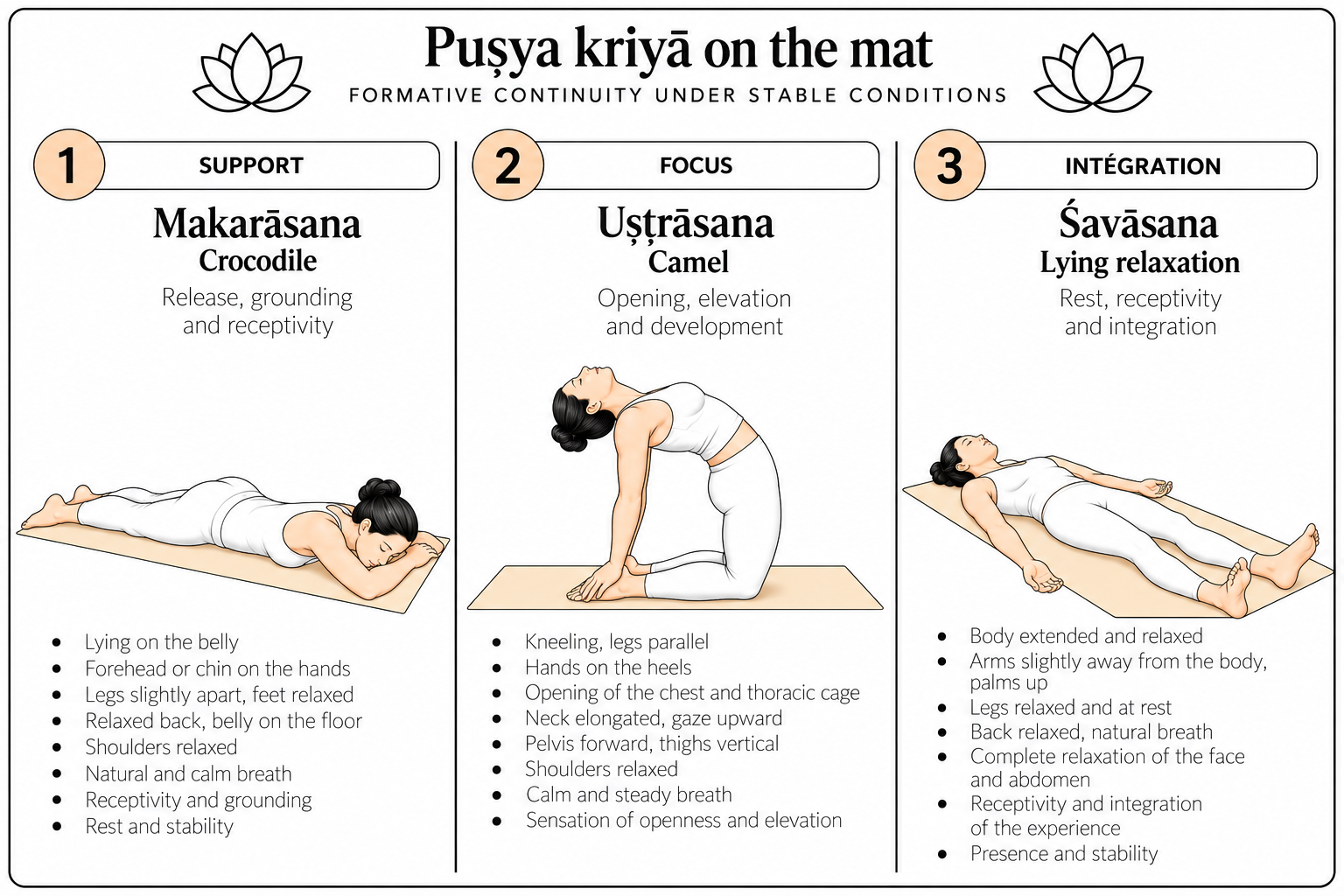
Puṣya kriyā on the mat
01

Support

Makarāsana

Crocodile

Concrete purposeMaintain stable conditions long enough for continuity to form, without increasing intensity once the form is established.

1. Settle in

Lie on the belly and arrange the forearms so the upper body can rest without neck tension.

2. Enter and hold

Support — Makarāsana — Crocodile. Let the floor receive the front of the body, relax the legs and keep breathing free in the back and sides.

Desired sensation

The movement is complete when load and geometry have remained stable while at least one accessory effort decreased ; breathing has not shortened ; and exit can begin without collapse, trembling or a desire to prolong for further gains.

Success criterion

The movement is complete when load and geometry have remained stable while at least one accessory effort decreased ; breathing has not shortened ; and exit can begin without collapse, trembling or a desire to prolong for further gains. Maximum duration is never a criterion. A brief, truly stable hold is better than a prolonged posture that requires stiffening.

Adaptations, exit and precautions

Simple variationClearly reduce the range, keep knees free and stop before any compensation. A small, clear form is better than a large range that is hard to leave.

Mistakes to avoidIncreasing range during the hold or confusing continuity with endurance. Do not add a second intensification once the phase criterion is met.

Physical cautionsReduce or stop in case of pain, dizziness, numbness, increasing joint discomfort or lasting loss of comfortable breathing. No maximum range is sought. Keep the neck free and avoid compensating for opening with lower-back compression.

02

Target

Uṣṭrāsana

Camel

1. Settle in

From Support, prepare the transition towards Uṣṭrāsana — Camel. Kneel with knees hip-width apart, pelvis above the knees and hands initially on the sacrum or hips.

2. Enter and hold

Target — Uṣṭrāsana — Camel. Lift the sternum and open the front of the body in a moderate extension. Keep the neck long and do not reach for the heels if this increases lower-back compression. Establish a moderate load and clear geometry, then stop increasing either. Dosage : Choose one Uṣṭrāsana range and hold it for at most 2–4 spontaneous breaths if they remain simple. Exit as soon as compensation appears.

Desired sensation

The movement is complete when load and geometry have remained stable while at least one accessory effort decreased ; breathing has not shortened ; and exit can begin without collapse, trembling or a desire to prolong for further gains.

Success criterion

The movement is complete when load and geometry have remained stable while at least one accessory effort decreased ; breathing has not shortened ; and exit can begin without collapse, trembling or a desire to prolong for further gains. Maximum duration is never a criterion. A brief, truly stable hold is better than a prolonged posture that requires stiffening.

Adaptations, exit and precautions

Simple variationClearly reduce the range, keep knees free and stop before any compensation. A small, clear form is better than a large range that is hard to leave.

Mistakes to avoidIncreasing range during the hold or confusing continuity with endurance. Do not add a second intensification once the phase criterion is met.

Physical cautionsReduce or stop in case of pain, dizziness, numbness, increasing joint discomfort or lasting loss of comfortable breathing. No maximum range is sought. Keep the neck free and avoid compensating for opening with lower-back compression.

03

Integration

Śavāsana

Lying relaxation

Leaving the posture

Integration — Śavāsana — Lying relaxation. Lie on the back, legs and arms comfortably placed, head aligned and weight fully given to the floor. Stop all unnecessary voluntary action. Let breathing regulate itself and check that the body no longer tries to prolong the previous phase. Begin unloading before fatigue.

Desired sensation

The movement is complete when load and geometry have remained stable while at least one accessory effort decreased ; breathing has not shortened ; and exit can begin without collapse, trembling or a desire to prolong for further gains.

Success criterion

The movement is complete when load and geometry have remained stable while at least one accessory effort decreased ; breathing has not shortened ; and exit can begin without collapse, trembling or a desire to prolong for further gains. Maximum duration is never a criterion. A brief, truly stable hold is better than a prolonged posture that requires stiffening.

Adaptations, exit and precautions

Simple variationClearly reduce the range, keep knees free and stop before any compensation. A small, clear form is better than a large range that is hard to leave.

Leaving the postureIntegration — Śavāsana — Lying relaxation. Lie on the back, legs and arms comfortably placed, head aligned and weight fully given to the floor. Stop all unnecessary voluntary action. Let breathing regulate itself and check that the body no longer tries to prolong the previous phase. Begin unloading before fatigue.

Mistakes to avoidIncreasing range during the hold or confusing continuity with endurance. Do not add a second intensification once the phase criterion is met.

Physical cautionsReduce or stop in case of pain, dizziness, numbness, increasing joint discomfort or lasting loss of comfortable breathing. No maximum range is sought. Keep the neck free and avoid compensating for opening with lower-back compression.