← All this month’s guidesHTML guideChair version

AstroYoga · Kriyā on the mat · 15

Svātī

Recenter the will in the body, then deploy it clearly from the flanks, kidneys and thoraco-abdominal center.

SupportTargetIntegration
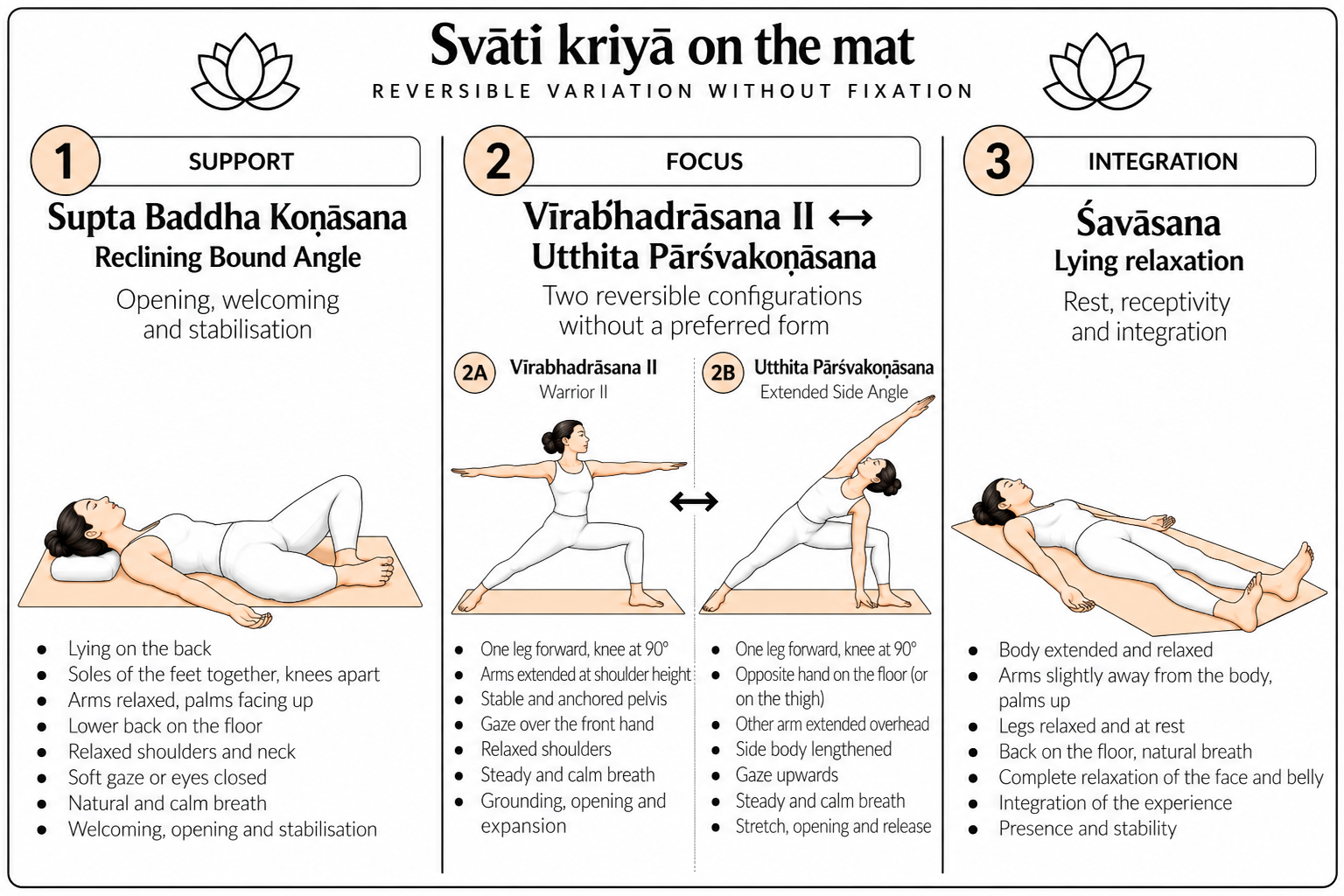
The three postures of the Svātī kriyā on the mat
01

Support

Adho Mukha Śvānāsana

Downward-Facing Dog

Concrete purposeAwaken the flanks, stabilize the kidneys and gather the breath into a center capable of orienting movement.

1. Settle in

Come onto all fours. Place the hands under the shoulders. Anchor the toes.

Spread the fingers. Lengthen the back of the neck. Press the floor away with the hands.

2. Enter and hold

Lift the knees. Move the pelvis upward and backward. Lengthen the flanks and back. Keep the knees slightly bent if needed.

Let the kidneys stabilize. Gather the breath into the center. Do not immediately try to place the heels on the floor.

Desired sensation

Feel the flanks more alive, the kidneys steadier, and the breath less dispersed.

Success criterion

The hands press clearly, the kidneys do not collapse, and the breathing remains full in the flanks.

Adaptations, exit and precautions

Simple variationKeep the knees more bent and the pelvis less high.

Exiting the posturePlace the knees back on the floor. Return to all fours. Allow one calm breath.

Mistakes to avoidForcing the heels toward the floor. Excessively rounding the back. Hardening the throat.

ContraindicationsWrist pain, unstabilized hypertension, dizziness, very sensitive shoulders.

02

Target

Pārśvakoṇāsana

Side Angle

Concrete purposeRecenter the will in the body, then deploy it clearly from the flanks, kidneys and thoraco-abdominal center.

1. Settle in

Come to standing. Step the legs wide apart. Turn one foot outward and the other slightly inward.

Bend the knee of the turned foot. Strongly anchor the back foot. Open the thorax.

2. Enter and hold

Place the forearm on the front thigh, or the hand on a support. Extend the other arm over the ear. Create a long line from the back heel to the fingers.

Keep the flanks active. Stabilize the kidneys. Let the impulse move in one direction only.

Desired sensation

Feel a clear trajectory in the flanks, with an oriented impulse without leakage.

Success criterion

The back leg remains active, the trunk does not collapse, and the orientation remains clear.

Adaptations, exit and precautions

Simple variationPlace the forearm on the thigh and keep the upper arm on the hip.

Exiting the postureReturn to standing on an inhale. Bring the feet parallel. Change sides after one breath.

Mistakes to avoidCollapsing into the trunk. Losing the support of the back leg. Letting impulse become agitation.

ContraindicationsKnee pain, hip instability, low back pain if the trunk collapses, sensitive shoulder in the raised arm.

03

Integration

Sukhāsana

Simple Seated Pose

Concrete purposeSlow down without breaking, and gather the charge of will into a stable center.

1. Settle in

Sit cross-legged on a support, with the pelvis slightly higher than the knees.

Place the hands on the thighs or on the lower flanks. Gently lengthen the spine. Release the shoulders.

2. Enter and hold

Let the gaze rest forward. Calm the throat. Remain simple.

Let the breath become mobile but calmer. Stabilize the kidneys and center. Do not return into impulse.

Desired sensation

Feel the will more gathered, with a stable and available center.

Success criterion

The back remains upright without stiffness, the breath slows slightly, and attention does not disperse again.

Adaptations, exit and precautions

Simple variationSit on a chair if sitting on the floor is uncomfortable.

Exiting the postureRelease the hands. Change the crossing of the legs or return to a neutral seated position.

Mistakes to avoidCollapsing after the effort. Holding with dryness. Letting the attention move again in all directions.

ContraindicationsHip or knee discomfort without support, difficulty sitting comfortably on the floor.