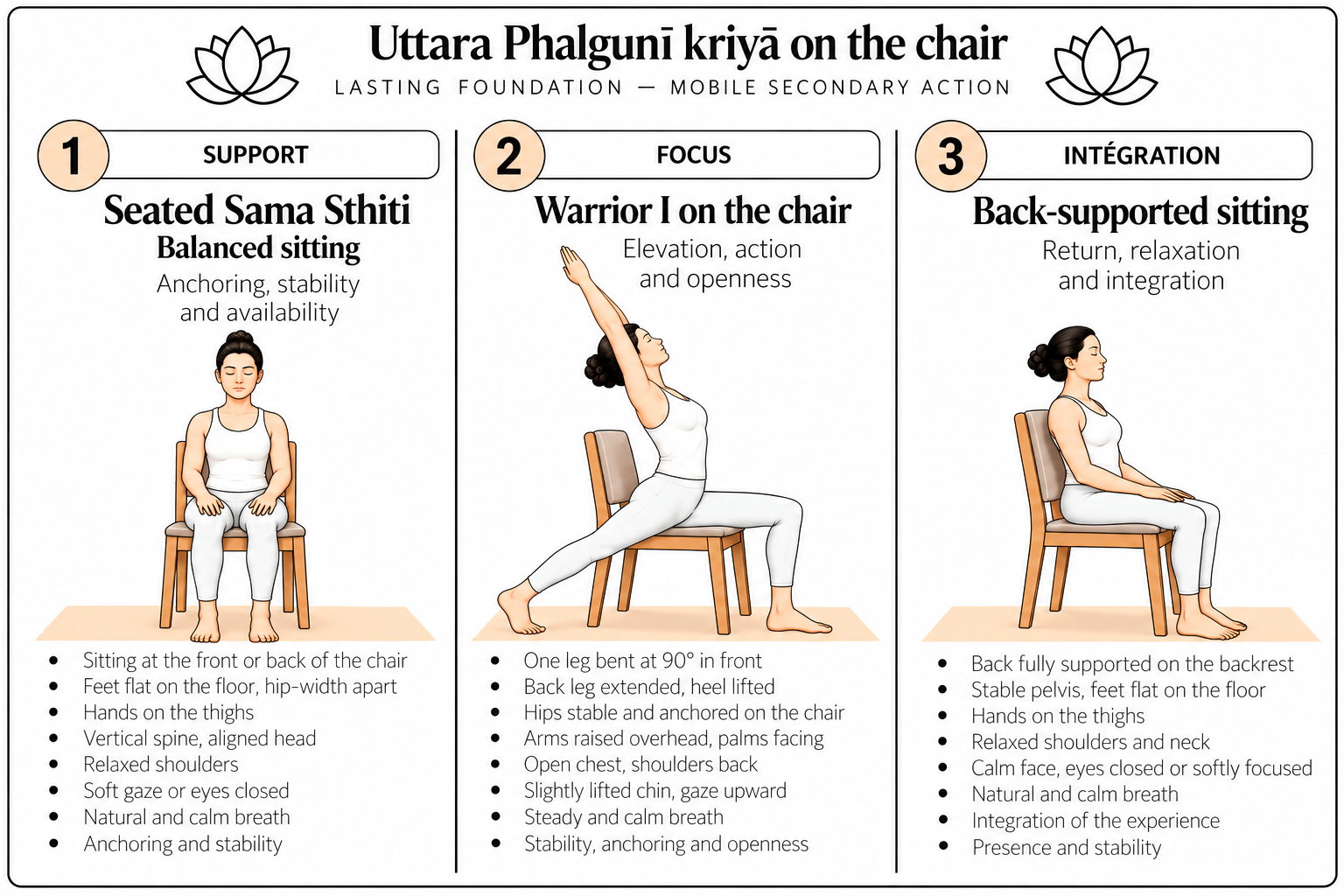
Support
Seated Sama Sthiti
Balanced sittingConcrete purposeKeep a lasting foundation while a secondary action moves, then return without disturbing the basic organisation.
1. Settle in
Sit in the centre of the chair, feet fully grounded, knees comfortably bent, pelvis stable and hands on the thighs.
2. Enter and hold
Support — Seated Sama Sthiti — Balanced sitting. Organise the trunk above the pelvis without rigidity. Keep the backrest available without leaning on it unless the phase calls for it.
Desired sensation
The movement is complete when the base remains clearly recognisable during a simple peripheral action without extra correction ; breath, face and throat remain ordinary ; the periphery can return to neutral without losing organisation ; and the whole posture can then be left without needing to hold it to demonstrate its stability.
Success criterion
The movement is complete when the base remains clearly recognisable during a simple peripheral action without extra correction ; breath, face and throat remain ordinary ; the periphery can return to neutral without losing organisation ; and the whole posture can then be left without needing to hold it to demonstrate its stability. The criterion is neither duration, lunge depth nor arm height. One clean peripheral action is enough.
Adaptations, exit and precautions
Simple variationReduce the range, keep more contact with the seat or backrest, or stay at the first stable stage. The variation must preserve the same grammar without turning the chair into a lever.
Mistakes to avoidStiffening the base to allow peripheral movement. Do not add a second intensification once the phase criterion is met.
Physical cautionsReduce or stop in case of pain, dizziness, numbness, increasing joint discomfort or lasting loss of comfortable breathing. No maximum range is sought. Check that the chair is stable, has no wheels and never becomes a pulling lever. Prioritise balance and stable supports ; reduce range before losing control of return.